
Zone-Level Axle Visibility & Dispatch Control with BLE RSSI + BLE AoA RTLS
Real-time axle tracking, dispatch-zone alerts and QR-based status visibility across a multi-client axle manufacturing facility
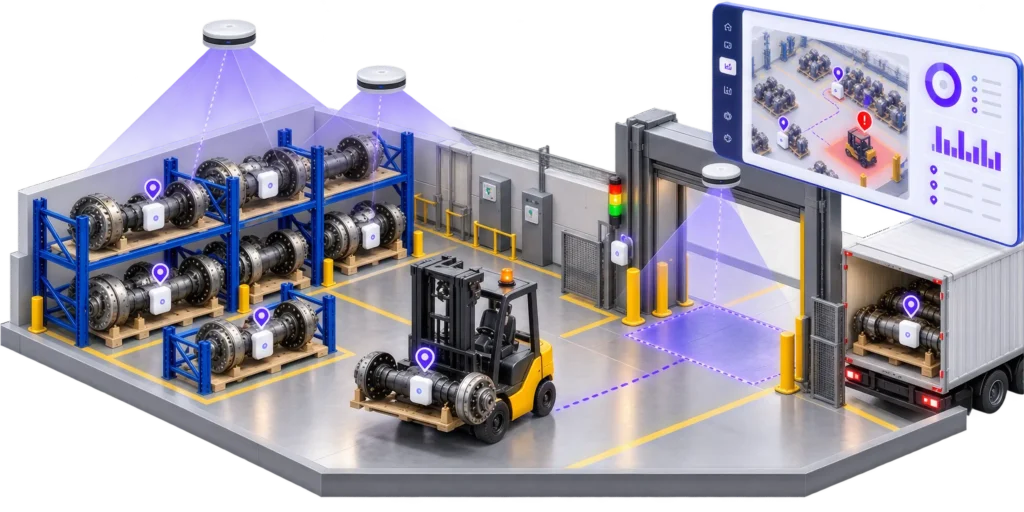
The Setup
A leading axle manufacturing organization supplies axles to multiple clients, with each client requiring different axle models and specifications. As each axle moves through production, finished goods storage (FGS), pre-delivery inspection (PDI), rework and dispatch, it is handled by forklifts and stored in zones that are often shared across clients and models.
As volumes and model variants grew, maintaining visibility of where each axle was, what its status was, and whether it was ready for dispatch became increasingly difficult.
The organization needed to move beyond manual registers and physical checks and build a system that provides real-time visibility of axle location, status and movement across the plant.
The requirement was therefore not simply to track axles.
It was to create a reliable digital identity for every axle, from FGS to dispatch.
Key Business Challenges
- Difficulty locating specific axles across FGS, PDI, rework and dispatch areas.
- No real-time visibility of the zone in which each axle was present.
- Manual effort to verify axle model, client and status.
- Risk of wrong or unapproved axles moving into the dispatch zone.
- No automated notification when an axle reached the dispatch zone.
- Forklift operators lacking an instant visual or audible cue at the dispatch point.
- Limited traceability of axle movement between zones.
- Difficulty identifying axles waiting too long in PDI or rework.
- Manual, error-prone status updates.
- Need for a scalable solution supporting multiple clients, models and growing volumes.
The Objective
The organization initiated a deployment to evaluate whether a combination of BLE RSSI, BLE Angle of Arrival (AoA) and QR/barcode-based identification could deliver reliable axle visibility and dispatch control in a live manufacturing environment.
The deployment focused on answering five fundamental questions:
- Can the zone of every axle be detected automatically in real time?
- Can the dispatch zone be monitored precisely, with instant alerts?
- Can forklift operators be guided visually and audibly at the point of movement?
- Can an axle's identity, client, model and status be verified with a single scan?
- Can the solution operate reliably alongside active production equipment?
The Approach
We designed the solution around actual plant workflows rather than a generic tracking demonstration.
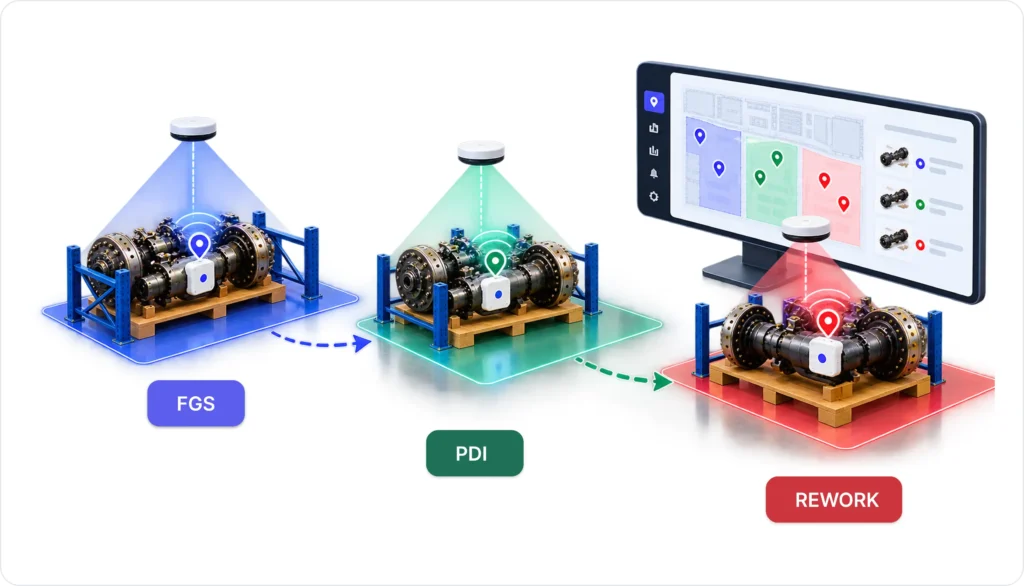
Two layers of positioning were used, matched to the accuracy each area actually needed.
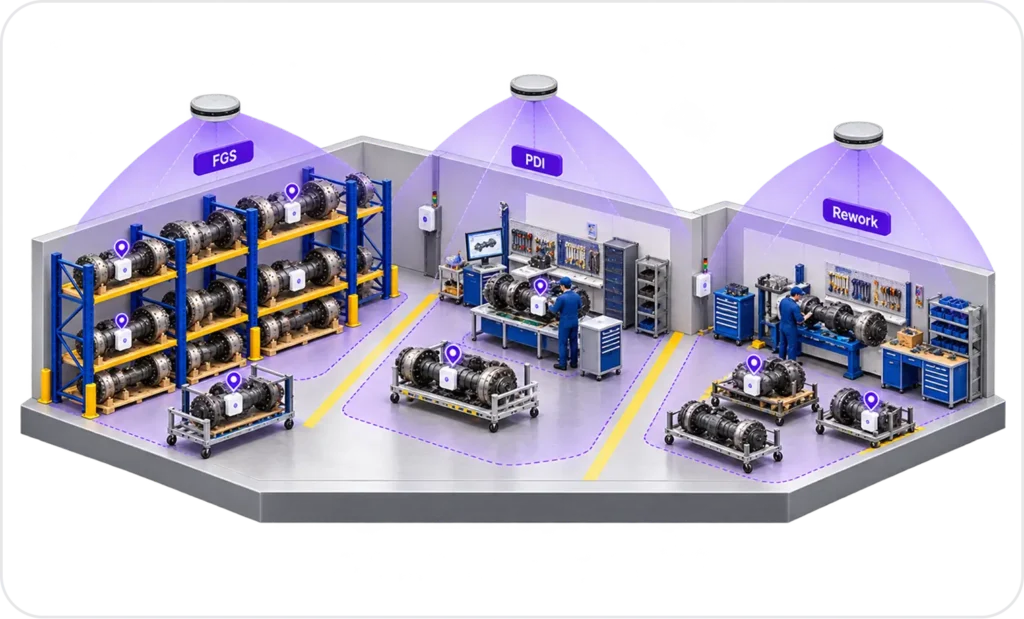
Zone-Level Presence Detection (BLE RSSI)
For FGS, PDI, rework and other holding areas, knowing which zone an axle is in is what matters. BLE RSSI-based detection provides efficient, cost-effective zone-level presence across these areas.
Precision Dispatch Monitoring (BLE AoA)
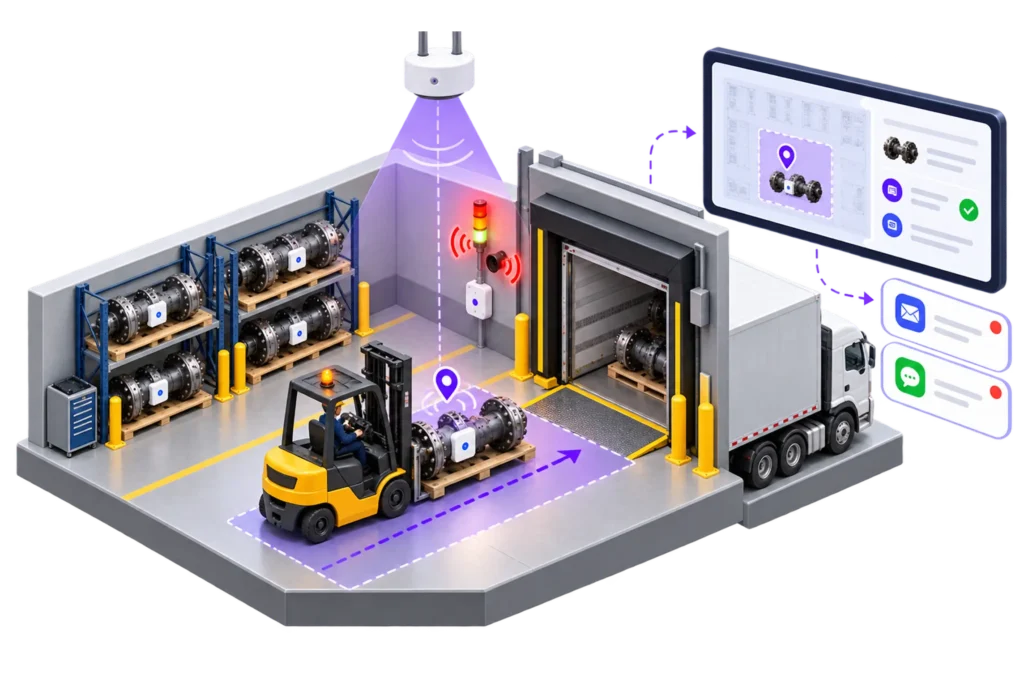
The dispatch zone is the most critical control point. BLE AoA provides the higher directional accuracy needed to detect when an axle enters the dispatch zone and trigger immediate action.
Planning the Deployment
The first stage involved understanding the plant layout and how axles move between process areas.
The deployment plan considered:
- Physical layout of the plant
- Zone definitions (FGS, PDI, Rework, Dispatch)
- BLE RSSI anchor and AoA anchor mounting locations
- Forklift movement paths at the dispatch zone
- Tag placement on axles
- QR/barcode identification workflow
- RF environment and structural obstructions
- Alert recipients and escalation
- Coexistence with production equipment
The plant was divided into logical tracking zones, so that location data translated directly into operational meaning. This became the basis for geofencing, dwell-time analytics, movement history and alerting.
The Solution
The solution combines BLE RSSI zone detection, BLE AoA dispatch monitoring, on-site forklift indication and QR/barcode-based identity and status management on one RTLS platform.
Solution Components
BLE Asset Tags with unique QR code
Attached to each axle; QR encodes axle unique number, model, client and status
BLE RSSI Anchors
Zone-level presence detection in FGS, PDI, Rework and other areas
BLE AoA Anchors
Precise detection of axles entering the dispatch zone
Anchor Unit + 2-Layer LED Tower Light with Buzzer
Visual and audible indication for forklift operators at the dispatch zone
QR / Barcode Scanner
Instant lookup of axle identity and current status
RTLS Server
Location engine, rules, alerts and data storage
Web Portal
Live dashboard, tag assignment, status updates and reports
Email & SMS Alert Engine
Notifies stakeholders when an axle enters the dispatch zone
Solution Flow
Smart Tag
BLE Anchors (RSSI / AoA)
Gateway
RTLS Server
Web Portal
Email / SMS / Tower Light
Tag-to-Axle Assignment
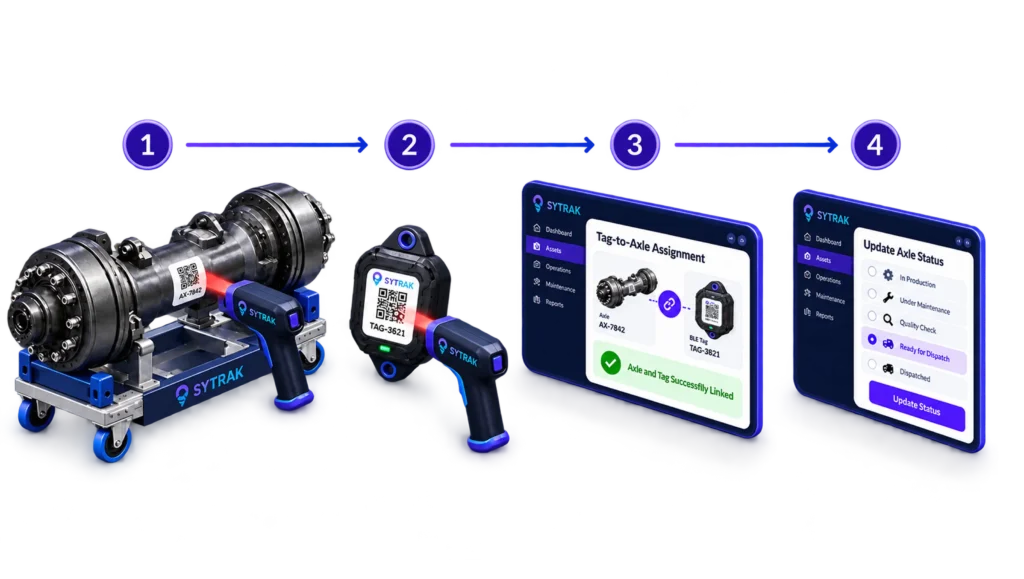
Accurate identity is the foundation of any RTLS. To keep the tag-axle link simple and error-free, assignment is done in two scans:
- 1. Scan the barcode / QR on the axle.
- 2. Scan the QR on the BLE tag.
- 3. The portal binds that tag to that axle.
- 4. Operators then add or update the axle status through the portal.
Tag QR Information
Axle Unique Number
Unique identifier of the axle
Model
Axle model
Client
Client for which the axle is manufactured
Status
Current status (e.g., FGS, PDI, Rework, Ready for Dispatch)
Putting the Solution to the Test
The deployment deliberately covered the real operating conditions of the plant: heavy axles, forklift traffic, metallic structures and zones shared across clients.
Zone Validation (BLE RSSI)
Tagged axles were moved between FGS, PDI and rework areas. The platform detected the zone of each axle and updated its location automatically as it moved.
Dispatch Zone Validation (BLE AoA)
Tagged axles were taken into the dispatch zone to validate detection and alerts. When an axle entered the zone:
- An email and SMS alert were generated to the configured recipients.
- The anchor unit's tower light and buzzer activated for the forklift operator.
Forklift Operator Indication
Operators are often too busy to look at a dashboard. A tower light with an audible buzzer at the dispatch zone puts the information where the work happens.
Layer 1 LED
[Define – e.g., Axle detected in dispatch zone]
Layer 2 LED
[Define – e.g., Axle not approved / attention required]
Buzzer
Audible alert to draw operator attention
Turning Location Data into Operational Intelligence
The platform delivered value well beyond showing a location. It turned raw positioning data into information that users could act on.
Search & Locate
Instead of searching physically across the plant, users search by axle number, model or client and see the current zone.
From
Search physically
Ask operators
Check multiple areas
Locate axle
To
Search digitally
Identify zone
Retrieve axle
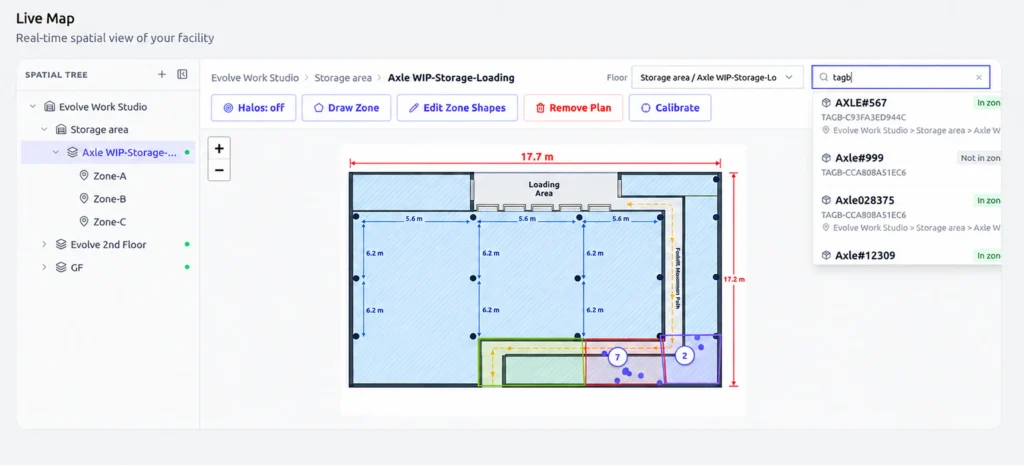
Real-Time Axle Visibility
A live view of axles across FGS, PDI, rework and dispatch, filterable by client, model and status.
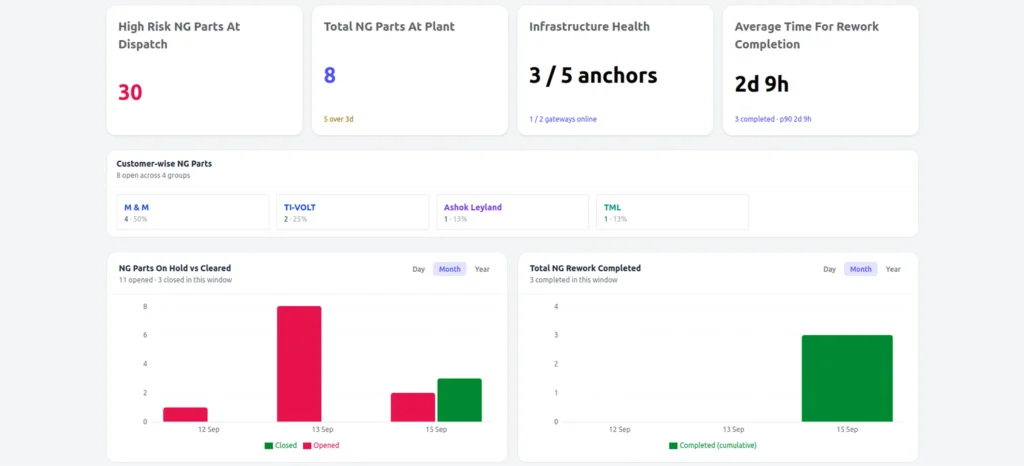
Geofencing & Dispatch Alerts
Virtual boundaries are configured around each operational zone. Entry and exit events are recorded, and dispatch-zone entry triggers alerts across email, SMS and tower light.
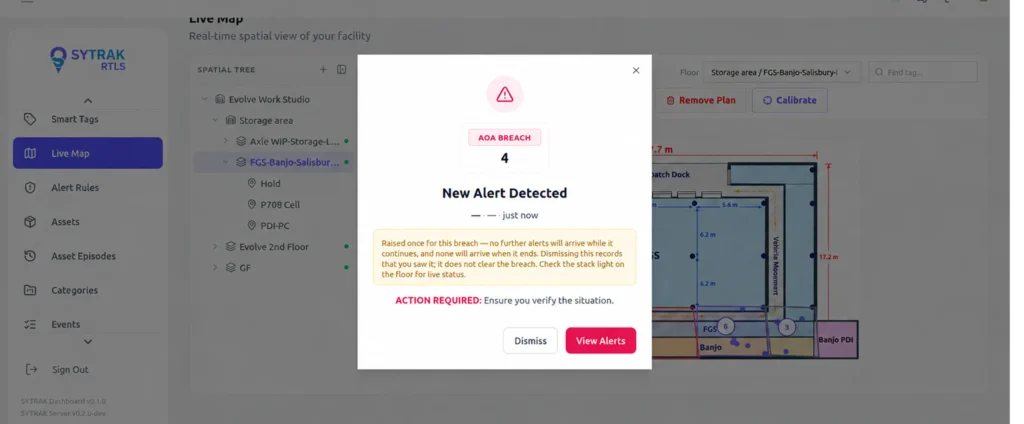
This supports:
- Dispatch-zone monitoring
- Restricted-area control
- Unplanned axle movement detection
- Zone transition tracking
Dwell-Time Analytics
The platform records entry and exit time for each zone, showing how long axles wait in FGS, PDI or rework.
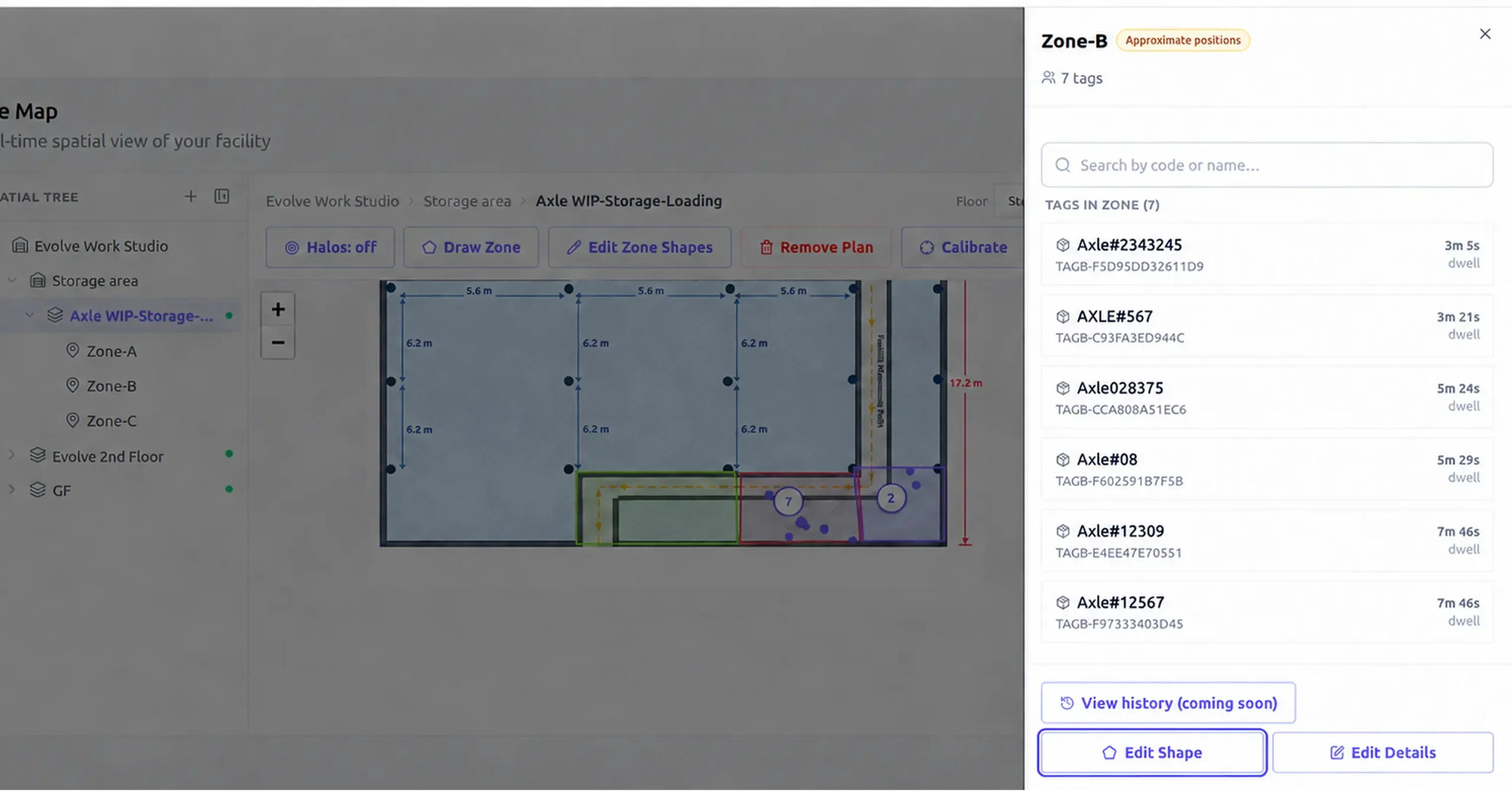
For example, an organization can identify axles that:
- Remain in rework longer than expected
- Wait too long for PDI
- Stay in FGS despite being needed for dispatch
- Spend excessive time in any single zone
Historical Movement & Playback
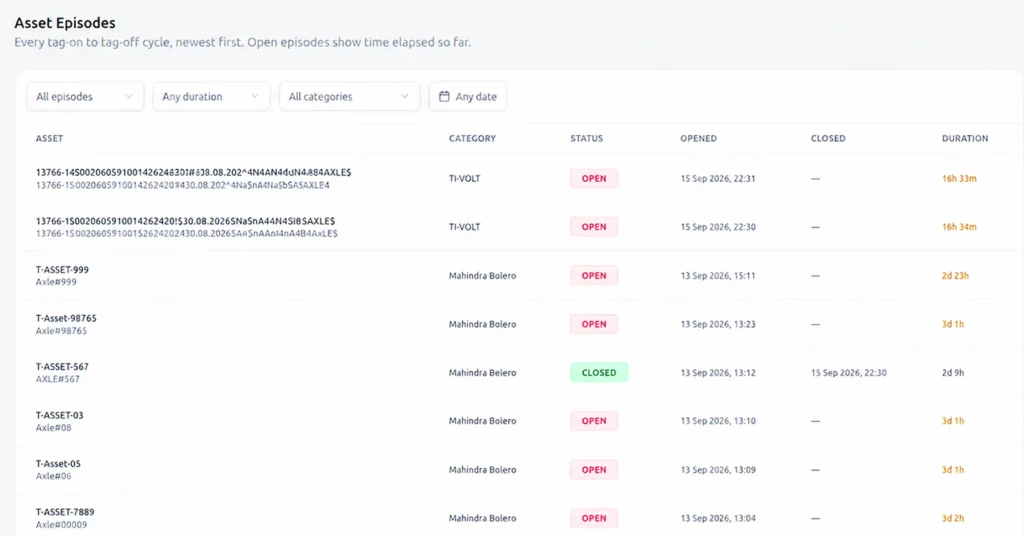
Every axle has a complete journey history across zones, and movement can be replayed over a selected period.
This is useful when investigating delays, wrong movements and quality-related queries.
Heatmap Analytics
Heatmaps show where axles spend the most time and where movement is concentrated, helping identify congestion and bottlenecks.
Event, Alarm, Tag & Battery Monitoring
All events and alarms are logged, and tag battery health is monitored so tags can be replaced before they fail.
Production Environment Coexistence
In an industrial deployment, accuracy alone is not enough. The RTLS must coexist safely with existing plant infrastructure.
RF and coexistence testing was carried out alongside operational production equipment under live conditions. [Add confirmed outcome, e.g., No abnormal behaviour was observed in plant operations.]
What the Deployment Demonstrated
Zone-level presence (BLE RSSI)
Axle zone detected automatically in FGS, PDI, Rework and other areas
Dispatch-zone detection (BLE AoA)
Precise detection at the dispatch zone
Email & SMS alerts
Stakeholders notified when an axle enters dispatch
Forklift indication
Tower light and buzzer guide operators in real time
QR-based identity
Unique axle number, model, client and status on every tag
Scan-based status check
Instant status lookup using QR / barcode scanner
Easy tag assignment
Two-scan tag-to-axle binding
Search & Locate
Any axle found digitally
Dwell-time & history
Zone time and full movement trail
Heatmaps & reports
Spatial activity analysis
From Deployment to an Axle Intelligence Platform
Every axle becomes a digitally identifiable entity carrying:
At scale, this opens up:
Dispatch Readiness
Know which axles are ready, pending or held.
Operational Efficiency
Reduce unnecessary handling and waiting.
Process Optimization
Use dwell and movement data to find bottlenecks.
Client-Wise Traceability
Maintain movement history per client and model.
Accountability
Maintain a digital link between each axle and its tracking identity.
Business Value
Reduced Search Time
Axles are located digitally instead of physically
Dispatch Accuracy
Alerts help ensure only the right axles move to dispatch
Faster Operator Response
Light and buzzer cues at the point of movement
Better Visibility
One view across all zones and clients
Improved Traceability
Complete digital record of axle movement
Reduced Manual Effort
Automated tracking, scan-based status checks
Scalability
Architecture extends to more zones, clients and axles
The Transformation
Scaling Beyond the Deployment
The deployment provides a foundation for progressively expanding RTLS across the plant:
The solution can also extend to forklift and MHE tracking, personnel safety, anti-collision, and integration with ERP / MES systems.
Conclusion
Managing axles for multiple clients across FGS, PDI, rework and dispatch creates a fundamental visibility and control challenge.
The BLE RSSI and BLE AoA based RTLS addressed it by giving every axle a digital identity, tracking its zone in real time, alerting stakeholders at dispatch, guiding forklift operators on the spot, and making status available with a single scan.
The result is more than an asset tracking system. It is a foundation for real-time dispatch control and operational intelligence, enabling the organization to know where every axle is, what its status is, how long it has been there, and whether it is ready to leave the plant.
From knowing where axles are to controlling how they move through the business.
BLE RSSI + BLE AoA RTLS provides the foundation for that transformation.