
Smart Asset Visibility for Manufacturing & Warehousing with BLE AoA RTLS
Real-Time tracking and intelligent asset analytics for an environment with 10,000+ assets
The Setup
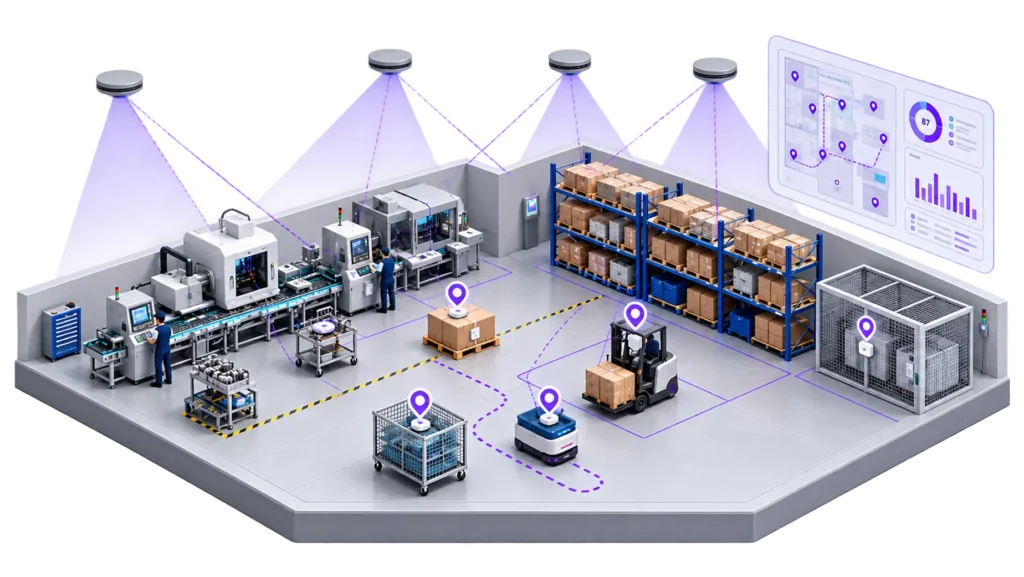
A large manufacturing organization was managing more than 10,000 assets across its production and warehouse environments. The asset population included equipment and components of different sizes, with assets frequently moving between operational areas, testing locations, storage zones, and other parts of the facility.
As the number of assets increased, maintaining visibility of their exact location became increasingly difficult.
The organization needed to move beyond conventional asset management methods and establish a system that could provide real-time visibility of where assets are, how they move, how long they remain in specific locations, and where they have been historically.
The challenge was particularly complex because the assets were not always positioned in open areas. Some were located inside equipment, cabinets, racks, shelves, and enclosed storage containers.
The requirement was therefore not simply to track assets.
It was to create a reliable digital visibility layer across the physical facility.
Key Business Challenges
- Difficulty locating specific assets across large operational areas.
- Limited real-time visibility into asset locations.
- Lack of automated asset movement history.
- Difficulty identifying assets that remained idle for extended periods.
- Limited visibility between production and warehouse environments.
- Manual effort involved in finding and verifying assets.
- Requirement to monitor assets across different zones.
- Need for analytics around asset movement and dwell time.
- Requirement for a scalable solution capable of supporting thousands of assets.
- Need to ensure that the tracking system could operate alongside existing production infrastructure.
The Objective
The organization initiated a Proof of Concept to evaluate whether BLE Angle of Arrival (AoA) based Real-Time Location System technology could provide reliable asset visibility in real-world manufacturing conditions.
The organization initiated a Proof of Concept to evaluate whether BLE Angle of Arrival (AoA) based Real-Time Location System technology could provide reliable asset visibility in real-world manufacturing conditions.
The PoC focused on answering five fundamental questions:
- Can assets be located in real time?
- Can users quickly find a specific asset?
- Can the complete movement history of an asset be understood?
- Can asset behaviour such as dwell time and zone movement be analysed?
- Can the technology operate reliably within an active industrial environment?
The Approach
We designed the PoC around actual operational scenarios rather than limiting the evaluation to an open-area tracking demonstration.
The selected areas represented two significantly different environments:
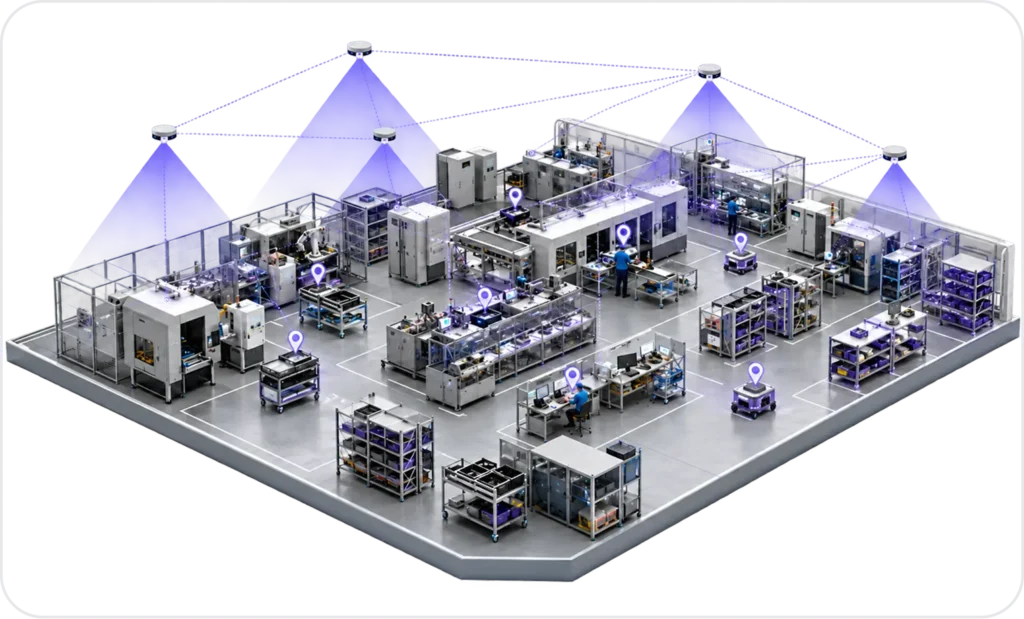
Production Environment
The production floor included active equipment, testers, racks, shelves, work areas, and other physical infrastructure.
This provided an opportunity to evaluate BLE AoA positioning in a dense industrial environment with multiple physical obstructions and operational equipment.
Warehouse Environment
The warehouse provided a different tracking scenario, with assets stored in different locations and, in some cases, inside enclosed containers.
Testing across both environments allowed the solution to be evaluated against a broader range of real-world asset tracking conditions.
Planning the PoC
The first stage involved understanding the facility layout and the way assets moved through the selected areas.
The deployment plan considered:
- Physical layout of the facility
- Anchor mounting locations
- Operational zones
- Required tracking coverage
- Asset locations
- Tag placement
- Typical asset movement
- RF environment
- Equipment and structural obstructions
- Production-system coexistence
The facility was divided into logical tracking areas, allowing location data to be translated into meaningful operational information
The facility was divided into logical tracking areas, allowing location data to be translated into meaningful operational informatRather than treating the facility as a single tracking space, the PoC established a digital representation of operational zones.
This became important later for geofencing, dwell-time analysis, movement history, and zone-based analytics.
The Solution
The PoC was implemented using a BLE AoA based RTLS architecture.
BLE asset tags were associated with selected assets, while strategically positioned BLE AoA anchors captured the signals required for location estimation.
The location information was processed through the RTLS platform and presented through a centralized visualization and analytics interface.
Solution Flow
Smart Tag
BLE Beacon
LoRaWAN Gateway
RTLS Server
Web Dashboard
The platform created a digital representation of the physical environment, allowing users to view assets and analyse their movement through the facility.
Putting the Solution to the Test
The PoC deliberately included challenging asset-placement scenarios to determine whether the technology could perform under actual operating conditions.
Tags were positioned on representative assets across the production environment, including locations such as equipment, testers, racks, and shelves.
The evaluation also included assets positioned deep inside tester equipment, including locations near the bottom of equipment.
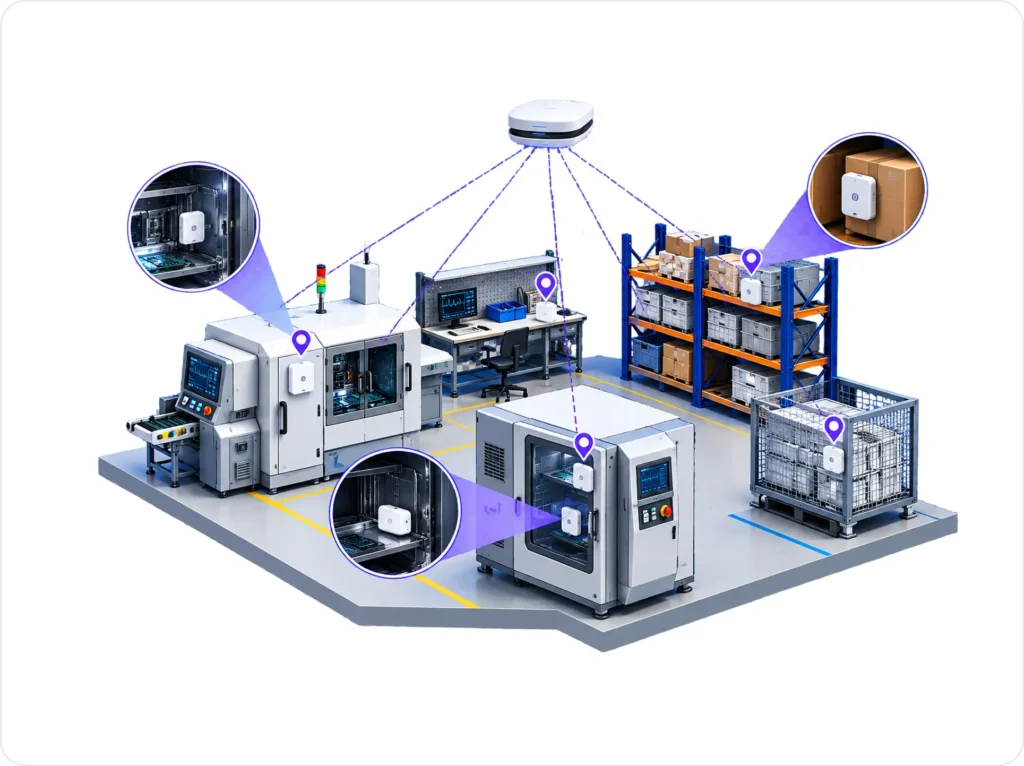
This was important because real-world assets are rarely positioned in ideal open spaces.
The system was able to continue providing location visibility in these scenarios, demonstrating the practical potential of BLE AoA tracking in complex industrial environments.
Warehouse Validation
The same approach was extended into the warehouse environment.
Assets were placed inside enclosed wooden storage containers of different sizes to understand how the system performed when assets were not directly exposed in an open environment.
The system continued to track the tagged assets and detect their movement.
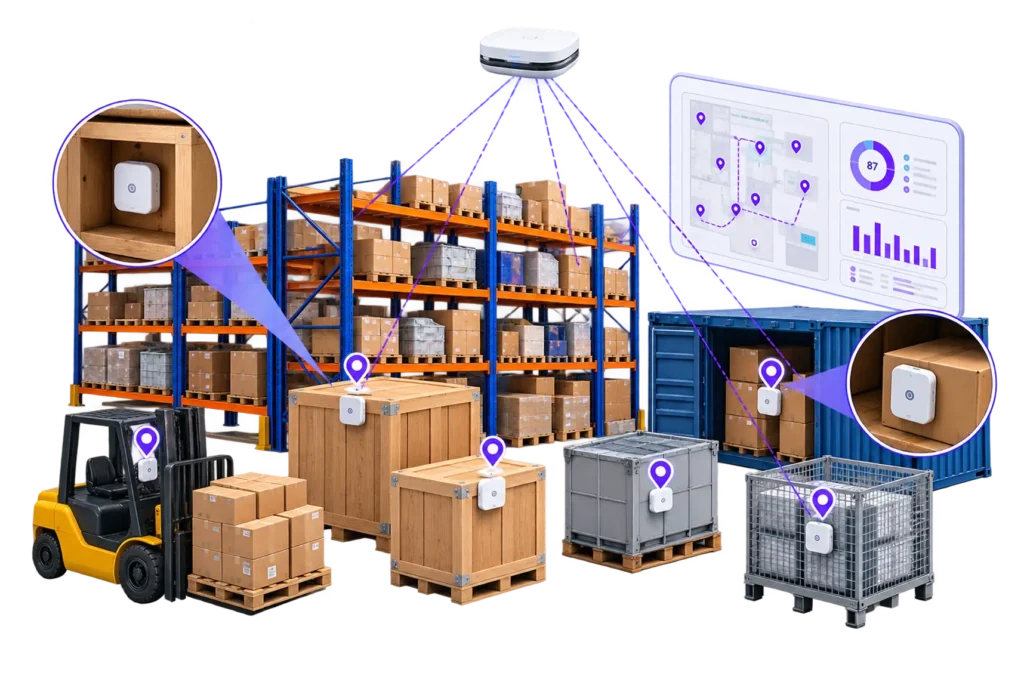
This provided additional confidence that the solution could support asset visibility in warehouse environments where storage structures and physical obstructions are common.
Turning Location Data into Operational Intelligence
One of the most important outcomes of the PoC was that the platform demonstrated value beyond simply displaying an asset's location.
The RTLS platform transformed raw positioning data into operational information that users could understand and act upon.
Search & Locate
Instead of manually searching across a large facility, users could search for an asset within the platform and identify its current location.
This changes the asset retrieval process
From
Search physically
Ask operators
Check multiple areas
Locate asset
To
Search digitally
Identify location
Retrieve asset
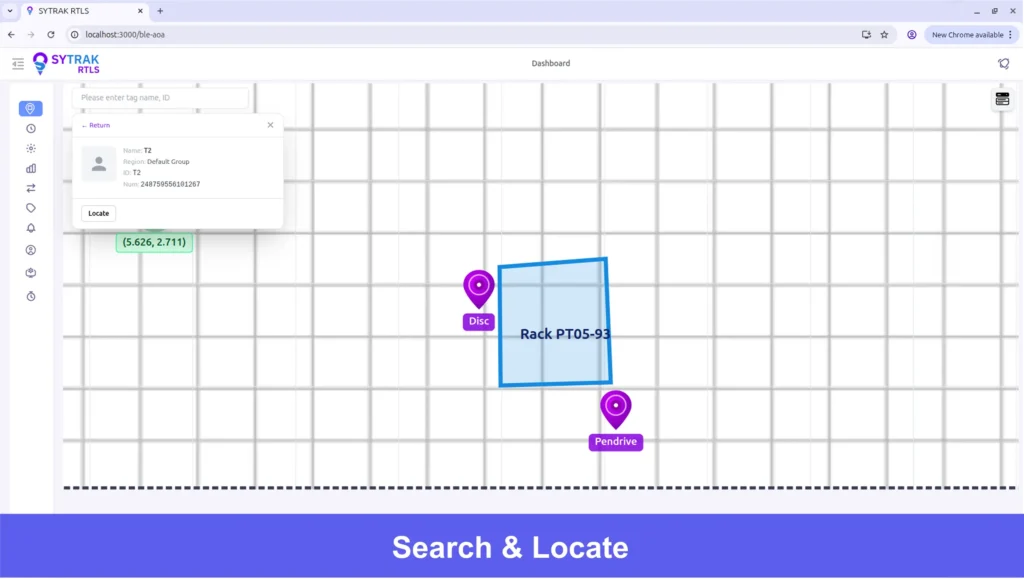
For a facility managing thousands of assets, even small reductions in search time can translate into significant productivity improvements.
Real-Time Asset Visibility
The platform provided a live view of tagged assets on the facility layout.
Users could understand where assets were located across operational zones without depending entirely on manual records or physical verification.
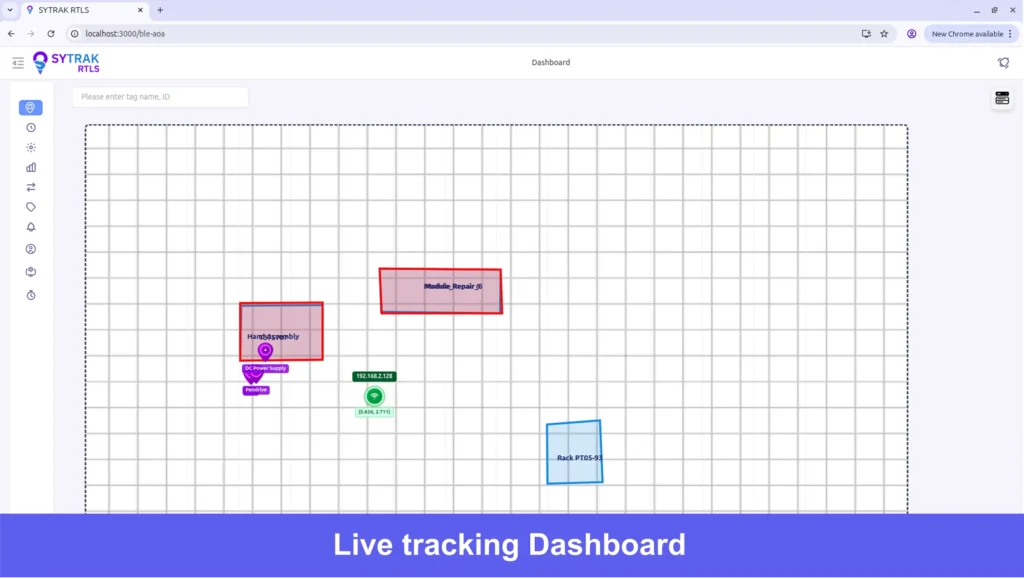
This created a centralized view of the physical asset landscape.
Geofencing
Virtual boundaries were configured around defined operational areas.
The platform could identify when assets entered or exited these zones and generate corresponding events or alarms.
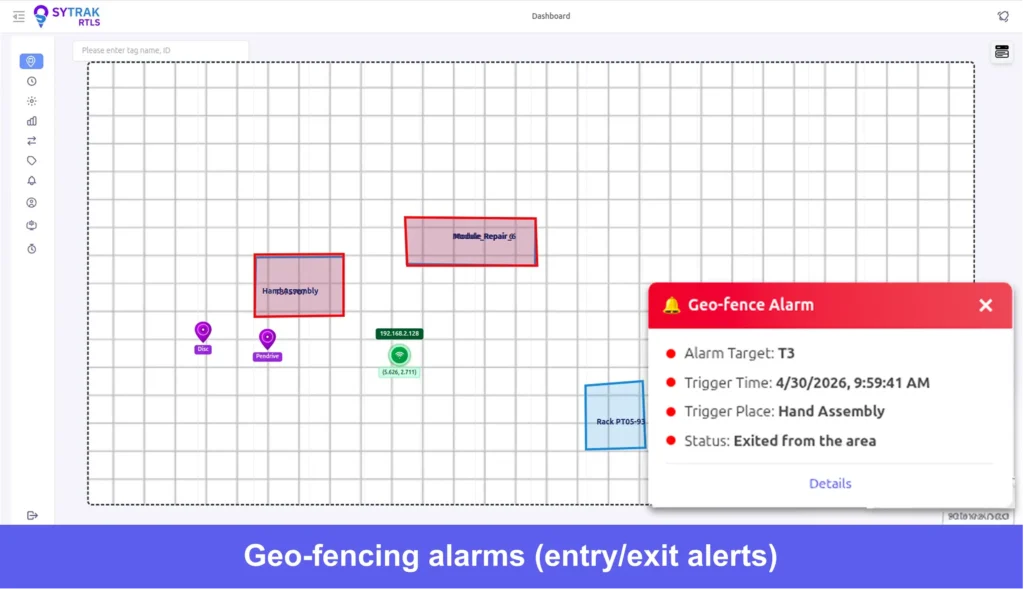
This capability can be used to support:
- Restricted-area monitoring
- Asset movement control
- Production-zone monitoring
- Warehouse boundary monitoring
- Unplanned movement detection
Dwell-Time Analytics
Knowing the location of an asset is useful.
Knowing how long it remains there is even more valuable.
The PoC demonstrated dwell-time analysis by recording when an asset entered and exited defined zones.
This creates visibility into asset waiting and utilization patterns.
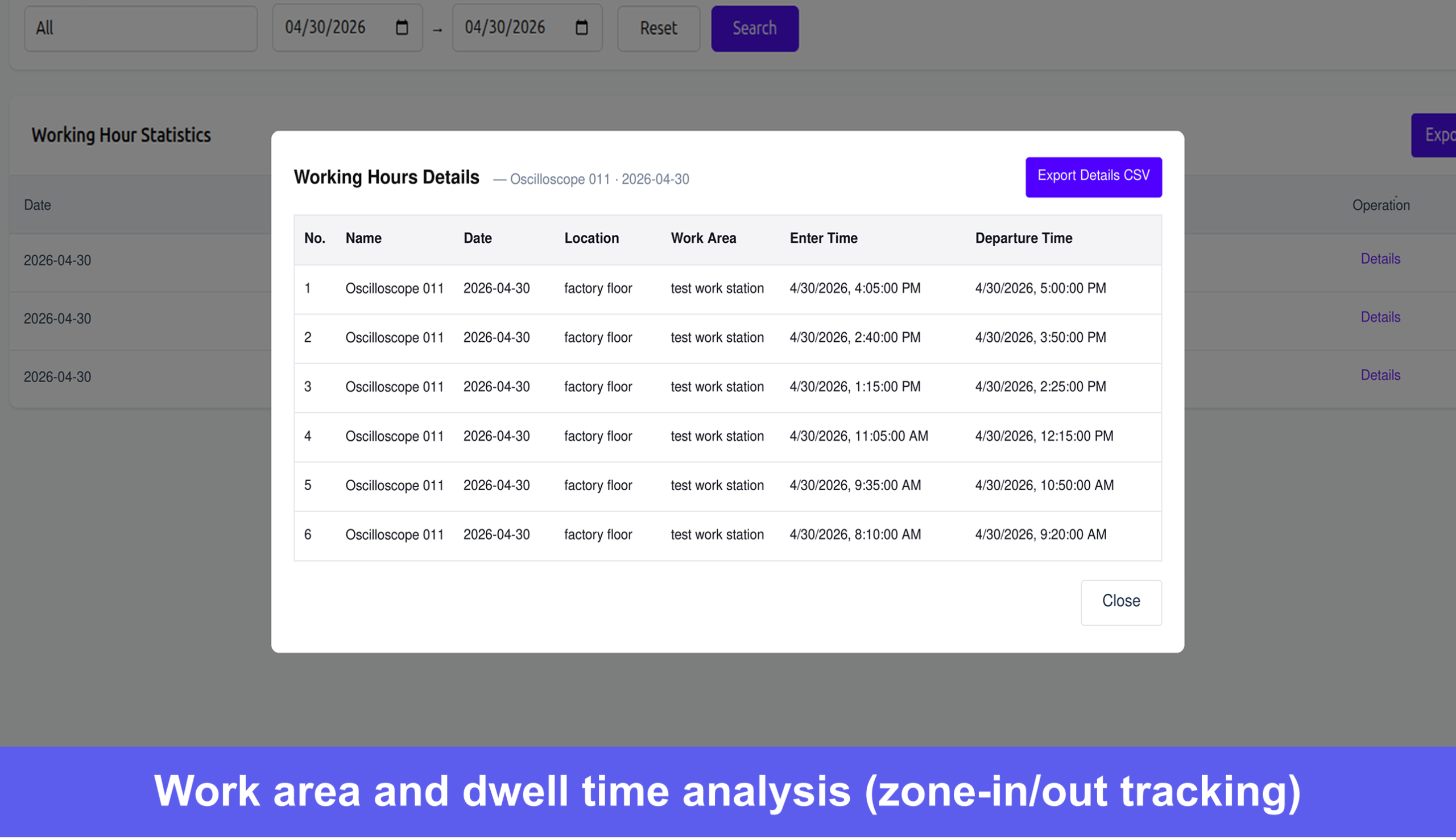
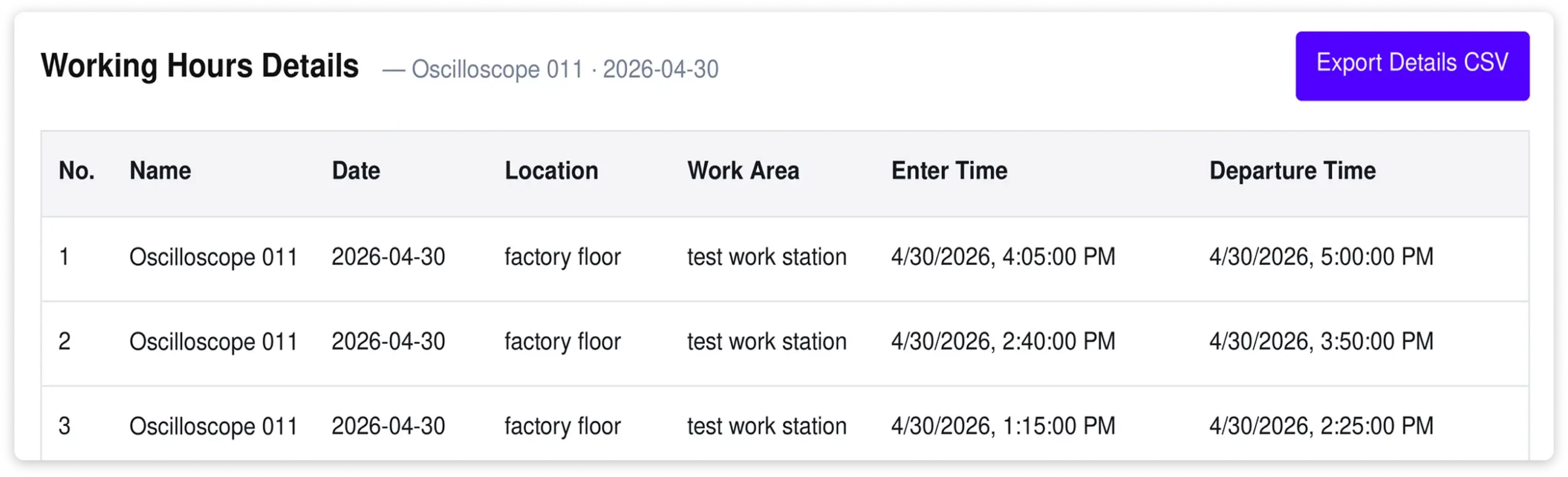
For example, an organization can identify assets that:
- Remain in storage for extended periods.
- Spend excessive time in a particular operational zone.
- Experience long waiting periods.
- Remain stationary despite being required elsewhere.
This information can become a valuable input for process optimization.
Historical Movement
The platform maintained historical location information, allowing users to understand an asset's movement over time.
Instead of viewing only the current position, users could examine the asset's journey through different zones.
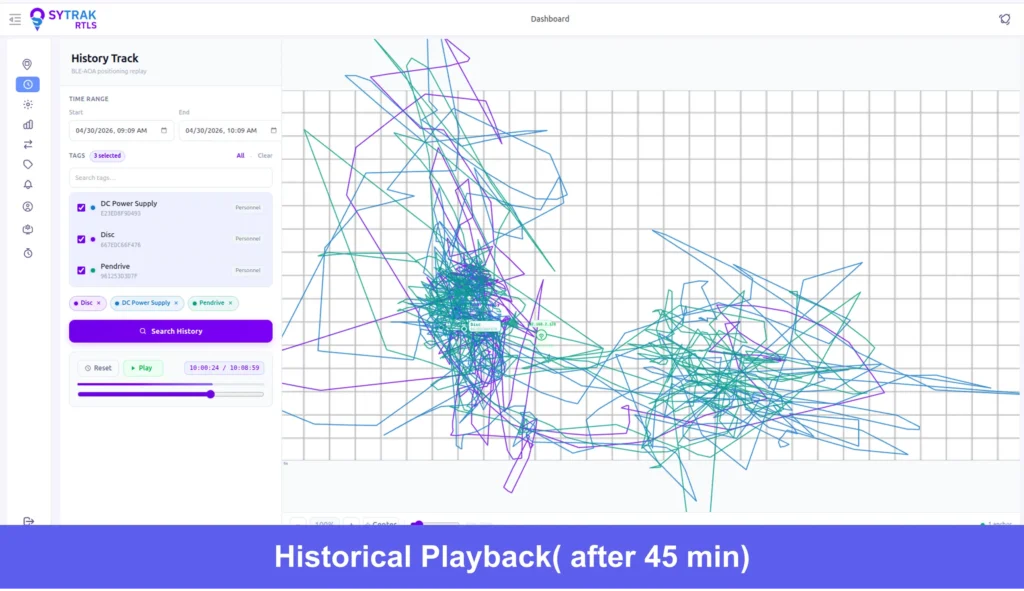
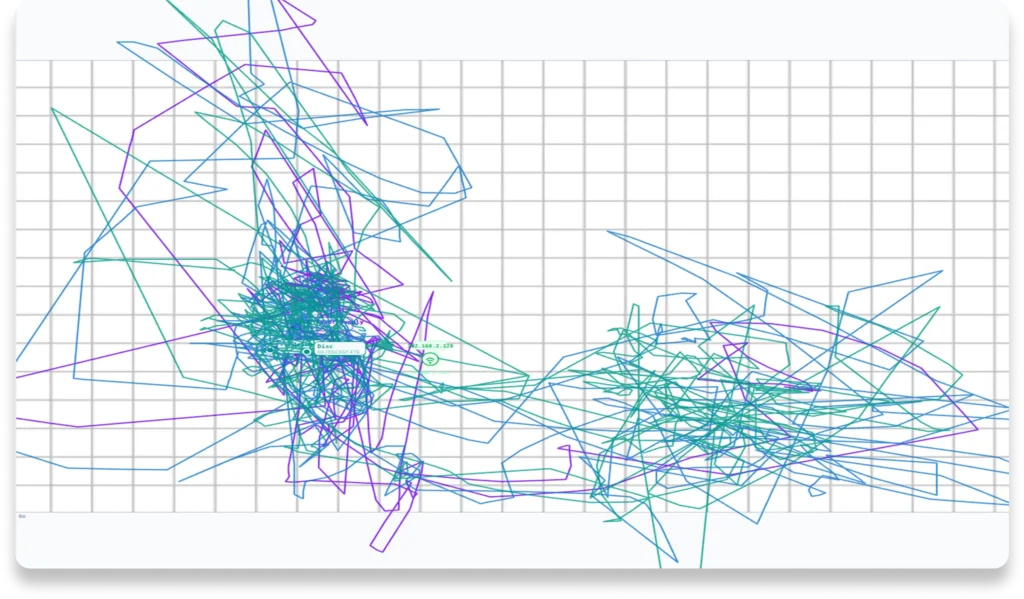
This provides an additional layer of traceability and operational understanding.
Movement Playback
Historical movement could also be replayed through the platform.
A user could visually follow an asset's journey across the facility over a selected period.
This can be useful when investigating:
- Asset movement
- Operational delays
- Unexpected asset locations
- Process inefficiencies
- Historical events
Heatmap Analytics
The platform also demonstrated heatmap visualization to understand asset activity across the facility.
Heatmaps can provide an aggregated view of where assets spend the most time or where movement is concentrated.
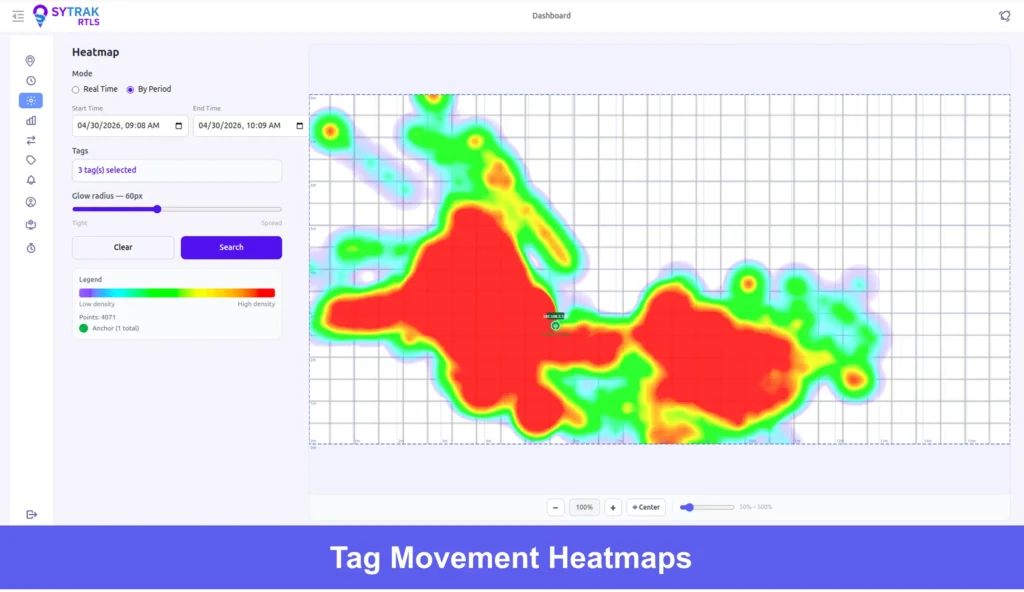
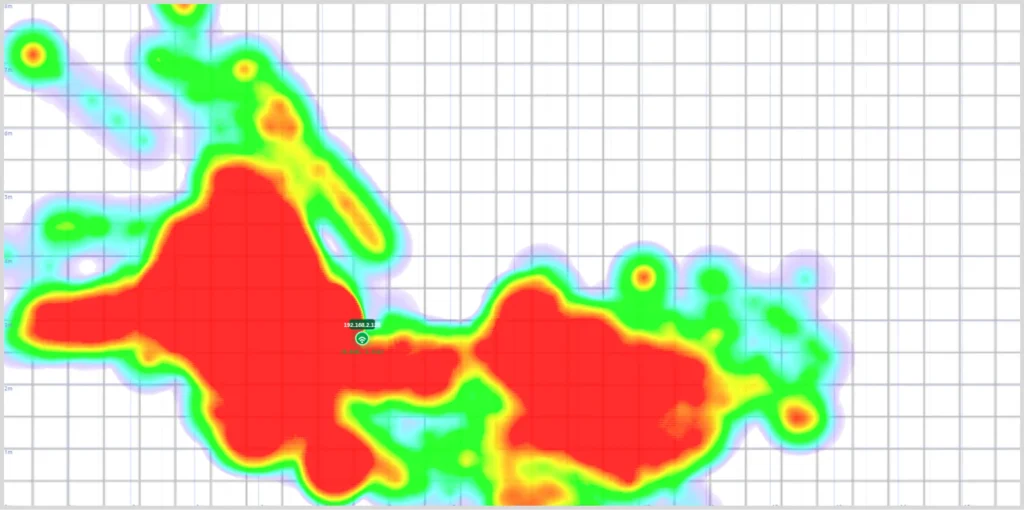
This can help identify:
- High-activity areas
- Asset congestion
- Frequently used zones
- Underutilized areas
- Potential process bottlenecks
Production Environment Coexistence
For an industrial deployment, location accuracy alone is not enough.
The RTLS system must also coexist safely with the organization's existing production infrastructure.
Therefore, RF and coexistence testing formed an important part of the PoC.
The RTLS setup was evaluated alongside operational production equipment, including extended testing under live operating conditions.
During the validation, the production environment continued to operate normally and no abnormal behaviour associated with the RTLS system was observed.
This provided an important validation point for future consideration of RTLS within active production areas.
Addressing a Practical Deployment Challenge
During the PoC, another important consideration emerged: maintaining the association between an asset and its assigned tag.
In a large-scale deployment, a tag that is accidentally removed or transferred to another asset can compromise asset identity and tracking accuracy.
To address this, a tamper-resistant wire-based tag mounting approach was proposed.
This creates a more secure physical association between the tag and the asset and can help reduce accidental tag reassignment during day-to-day operations.
This is an example of how the PoC was used not only to validate technology, but also to identify practical considerations for production deployment.
What the PoC Demonstrated
The PoC successfully demonstrated the ability of BLE AoA RTLS to provide real-time asset visibility across both manufacturing and warehouse environments.
The evaluation demonstrated:
Real-time location tracking
Assets could be visualized through the RTLS platform.
Search & Locate
Specific assets could be quickly identified and located.
Geofencing
Virtual zones could be created for asset monitoring and alerts.
Dwell-Time Analytics
Time spent by assets in different zones could be analysed.
Historical Movement
Previous asset movements could be reviewed.
Movement Playback
Asset journeys could be visually replayed.
Heatmap Analytics
Asset activity could be analysed spatially.
Event & Alarm Reporting
Asset-related events could be recorded and reviewed.
Tag & Battery Monitoring
The health and status of deployed tracking tags could be monitored.
Complex-Environment Tracking
Assets positioned inside equipment and enclosed containers could be tracked.
Production Coexistence
The RTLS system was evaluated alongside operational production equipment.
From a PoC to an Enterprise Asset Intelligence Platform
The PoC demonstrated that RTLS can solve a much broader problem than asset location.
For an environment with 10,000+ assets, the long-term value lies in creating a continuous digital record of asset activity.
Every asset can become a digitally identifiable entity with information such as:

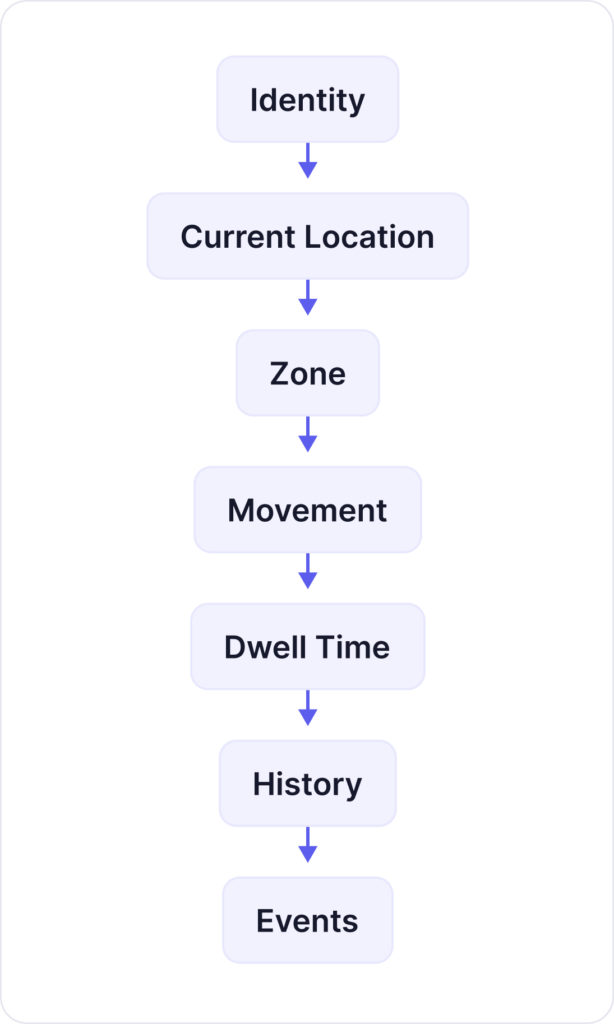
Once this data is available at scale, organizations can begin analysing how assets actually move through their operations.
This opens the door to applications such as:
Asset Utilization
Identify assets that are frequently used versus assets that remain idle.
Operational Efficiency
Understand unnecessary asset movement and long waiting periods.
Warehouse Optimization
Identify storage patterns and improve asset retrieval processes.
Process Optimization
Use movement and dwell-time data to identify bottlenecks.
Asset Accountability
Maintain a digital relationship between physical assets and their tracking identities.
Operational Traceability
Understand the movement history of assets across the facility.
Business Value
The PoC demonstrated how real-time location data can address several operational challenges associated with large-scale asset management.
The potential business value includes:
Reduced Asset Search Time
Employees can locate assets digitally rather than physically searching across large facilities.
Improved Asset Utilization
Dwell-time and historical movement data provide visibility into how assets are actually being used.
Better Operational Visibility
Production and warehouse assets can be viewed through a centralized platform.
Improved Traceability
Historical movement creates a digital record of asset activity.
Faster Decision Making
Users can make decisions based on real-time asset information rather than manual assumptions.
Reduced Manual Effort
Automated location and movement information reduces dependence on manual asset tracking.
Scalable Asset Management
The architecture provides a foundation for extending tracking to thousands of assets across larger areas.
The Transformation
The fundamental transformation enabled by the solution can be summarized as:
Scaling Beyond the PoC
The successful PoC provides a foundation for progressively expanding RTLS coverage across a larger operational environment.
A potential deployment roadmap can begin with selected critical assets and zones and progressively expand to:
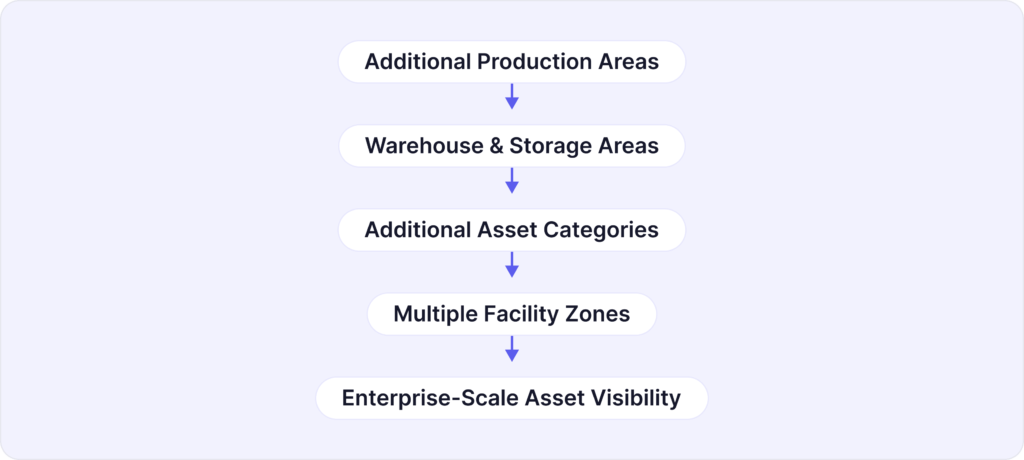
With the ability to support a large population of tagged assets, the RTLS platform can eventually become a centralized operational intelligence layer connecting physical asset movement with digital business systems.
The solution can also be extended to additional use cases such as equipment utilization, material movement, personnel tracking, safety monitoring, and process optimization.
Conclusion
Managing more than 10,000 physical assets across a large manufacturing environment creates a fundamental visibility challenge.
The successful BLE AoA RTLS PoC demonstrated how this challenge can be addressed by creating a real-time digital representation of physical assets across both factory and warehouse environments.
The solution successfully demonstrated real-time tracking, Search & Locate, geofencing, dwell-time analytics, heatmaps, historical movement, playback, event reporting, and tracking in complex asset-placement scenarios.
Importantly, the evaluation also considered practical deployment challenges such as tag security, physical obstructions, warehouse conditions, and coexistence with existing production systems.
The result is more than an asset tracking system.
It is a foundation for real-time asset intelligence—enabling organizations to understand not only where their assets are, but also how they move, how long they remain in different areas, how they are utilized, and where operational improvements can be made.
From knowing where assets are to understanding how assets move through the business.
BLE AoA RTLS provides the foundation for that transformation.